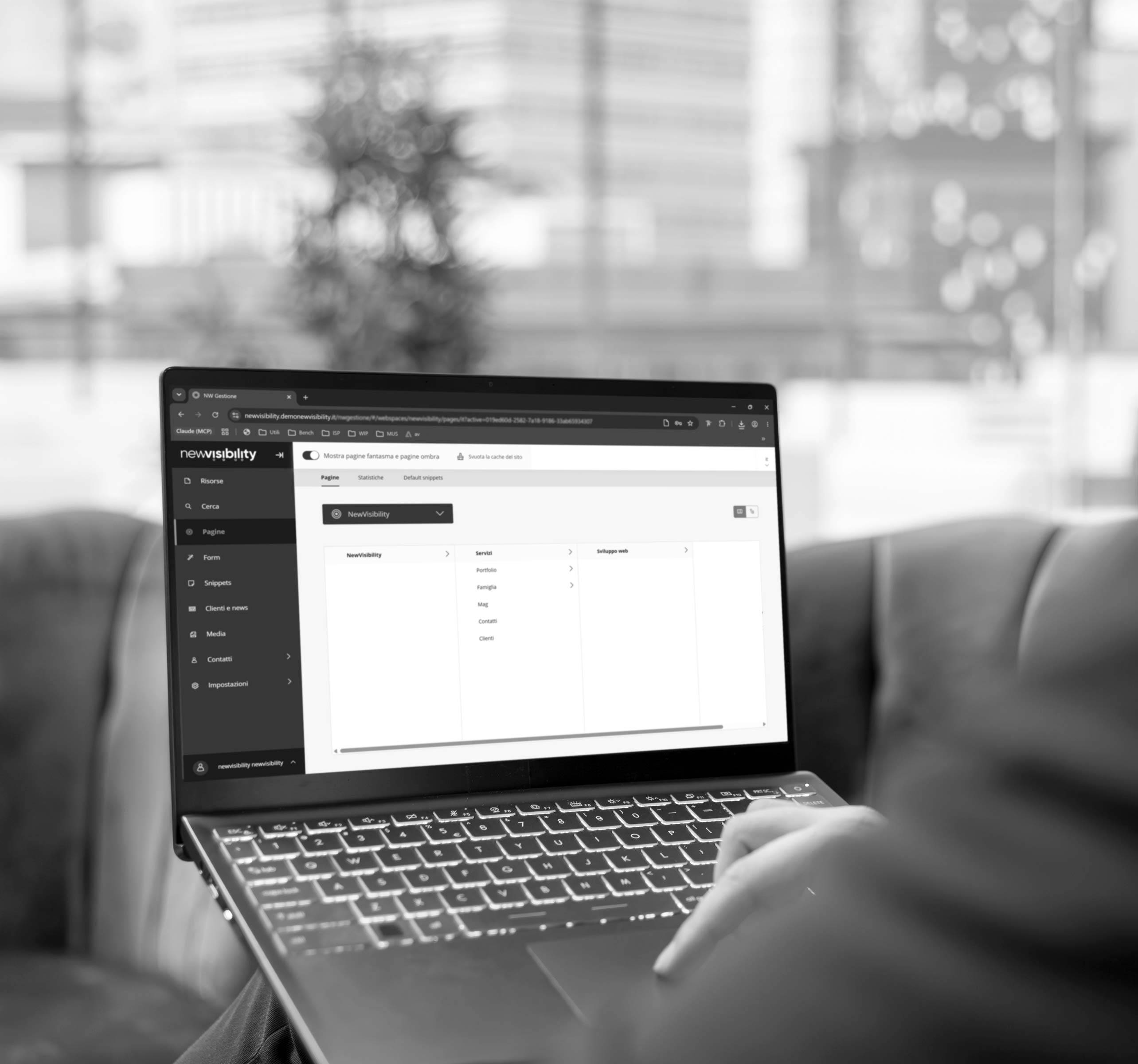
The structure is decided before the graphics and the copy. You need to establish which languages to activate, whether every page exists in every language or only some, how URL paths change and how users move from one version to another. A choice made well at the start avoids having to reorganise the site when you add a new market. With our enterprise CMS, which we use for our clients' websites, language management is native: each page has its language versions in the same content tree. From our office in Cantù, in the province of Como, we define this architecture with companies in Brianza and Milan before designing the site.
The elements of a multilingual structure
These are the points we define with you in the analysis phase, before designing the site.
One identity, several languages
The design stays the same in every version, but it has to cope with longer or shorter text: German takes up more space than English, and headings change length. That is why we design bespoke layouts that adapt to the content of each language without breaking.


Want to plan the structure of your multilingual website?
Tell us the languages and markets you have in mind: from Cantù we start there to define the architecture of your company's website, whether you are in Como, Milan or Lugano.
In the CMS, translations are managed by creating a version of each page in every language, with its own text, URL and meta tags. In our enterprise CMS you switch between languages from the same panel and see what is missing; from Cantù we support companies in Como and Milan in setting up translator permissions.
For a business website it often makes sense to combine them: AI translation speeds up the first draft, while professional review ensures terminology, tone and accuracy. Keywords should be researched for each country, not translated. With companies between Como, Milan and Lugano we define the mix case by case.
The hreflang tag is an indication in the code that tells search engines which language, and optionally which country, a page is written for, and what its alternative versions are. We set it up in Cantù on the multilingual sites of companies in Como, Milan and Ticino, to stop similar pages being seen as duplicates.
In a CMS, roles and permissions are managed by assigning each user a profile that defines which sections, languages and media they can view, edit or publish. With an enterprise CMS, like those we develop in Cantù for companies in Como and Milan, they are native and suit teams with several editors and branches.
The recurring costs of a website are the domain, hosting, SSL certificate, email accounts, technical maintenance and any licences for external services. With our open source enterprise CMS there are no CMS licences to pay, and from Cantù we manage hosting and maintenance for companies in Como and Milan.